Choosing a messaging platform used to be a straightforward decision. Today, for organizations in government, defence, and critical infrastructure, it is an architectural one. The wrong choice does not just limit features. It creates compliance gaps, sovereignty risk, and operational dependencies that formal security reviews will reject.
Open-source messaging platforms exist to solve a specific problem: organizations that cannot hand control of their communications to a vendor-managed cloud. That means the code must be inspectable, the data must stay inside the organization's own infrastructure, and the platform must keep running even when external networks go down. No commercial SaaS tool is built for those conditions.
This guide compares the top open-source messaging platforms available in 2026, with a focus on enterprise and government requirements: deployment flexibility, compliance coverage, federation capability, and what each platform can and cannot do in the environments where it matters most.
01What is an open-source messaging platform and how does it differ from proprietary?
An open-source messaging platform is a communication tool whose source code is publicly available, auditable, and modifiable. Any organization can inspect how the software works, verify its security claims, and adapt the code to fit its exact requirements. Proprietary platforms operate on the opposite model: the vendor controls the code, the infrastructure, and the terms under which the product runs.
Open-source messaging platforms cover the full range of features organizations expect from enterprise communication tools:
- Real-time messaging across channels, groups, and direct messages
- Voice and video calling
- File sharing and document collaboration
- Screen sharing
- Mobile and desktop applications
- Message search and full conversation history
- User management, roles, and access controls
- Notifications, mentions, and alerts
- Third-party integrations and APIs
- Audit logging and administrative controls
The practical difference comes down to control, auditability, and dependency. With a proprietary platform, organizations agree to the vendor's data-handling practices, encryption choices, and feature roadmap by using the product. With open-source software, organizations make those decisions themselves. Deployment can happen on private infrastructure, sovereign cloud, or an air-gapped network with no external connectivity. The code can be inspected by internal security teams, national certification bodies, or third-party auditors, not taken on faith.
For government agencies, defence organizations, and critical infrastructure operators, this distinction determines which platforms can legally and operationally be approved for use. An instant messaging platform built on vendor-controlled cloud infrastructure introduces a fundamentally different risk profile than one the organization deploys and governs itself.
Open-source software separates the software license from the data-hosting question. The organization chooses where data lives, who holds encryption keys, and how long messages are retained. No vendor can change those decisions unilaterally.
02Five reasons organizations choose open-source messaging over proprietary tools
- Auditability. The source code is visible and inspectable. Internal security teams, third-party auditors, and national certification bodies can verify exactly how messages are encrypted, how access controls work, and how data is retained or deleted. No trust required. The code is the evidence. For organizations pursuing formal accreditation, this is a prerequisite, not a feature. The advantages of open-source software go well beyond cost: transparency of the security posture is the primary value in regulated environments.
- Full data ownership. Self-hosted deployment means the organization owns the data, the keys, and the recovery process. There is no vendor with access to message content and no cloud provider subject to foreign jurisdiction. This directly addresses GDPR's data residency requirements and eliminates the Schrems II uncertainty that complicates US SaaS procurement for EU public sector bodies. Open-source enterprise software separates the software license from the data-hosting question entirely. The organization decides where data lives, not the vendor.
- Vendor independence. Proprietary platforms can change pricing, deprecate features, or shut down. Organizations have no recourse. With open-source software, the organization holds a copy of the code. The platform continues to operate regardless of the vendor's commercial decisions. NIS2's continuity requirements make this distinction operational: communications infrastructure cannot depend on a vendor's continued existence.
- Governed extensibility. Open-source platforms can be extended to cover workflows no off-the-shelf tool handles, through APIs, SDKs, and application frameworks, inside a governed security boundary. The organization decides which integrations are permitted, what data they can access, and what security review they must pass. This is different from a commercial plugin marketplace where extensions may carry broad, ungoverned access to sensitive communications.
- No licensing lock-in. Permissive licenses such as MIT impose no per-seat royalty and no vendor dependency through licensing terms. Organizations pay for support, infrastructure, and enterprise features, not for the right to run the software. For large deployments across agencies or coalition partners, the licensing model is as relevant as the feature set.
03Open-source vs. commercial SaaS: where proprietary platforms fall short
The self-hosting debate gets most of the attention, but deployment location is not the core distinction between open-source and proprietary messaging platforms. The more fundamental difference is in the trust model.
With a proprietary platform, organizations accept the vendor's claims about how the software works. How messages are encrypted, what data is collected, how access controls are enforced, whether the vendor can read communications. These are questions the organization cannot independently answer. The code is closed. The security posture is taken on faith.
With open-source software, the organization does not need to trust the vendor. It can verify. The source code is available for inspection by internal security teams, national certification bodies, and independent auditors. Every claim the platform makes about encryption, data handling, and access control can be tested against the actual implementation, not just a compliance statement.
For most commercial organizations, that distinction is theoretical. For regulated industries, it is a procurement requirement. Formal accreditation processes do not accept vendor certifications as a substitute for code-level review. An Authority to Operate in a US classified environment, BSI IT-Grundschutz compliance in Germany, or NCSC Secure by Design alignment in the UK all require the ability to assess the actual security posture of the technology. Closed-source software cannot satisfy that requirement regardless of how many third-party audits the vendor has passed.
There is a second layer to this distinction. Commercial SaaS platforms are not just closed-source: they are also built on infrastructure the organization does not control. The vendor manages the servers, the encryption keys, the data residency, and the feature roadmap. Organizations in regulated environments often cannot accept that dependency, not because of what the vendor does today, but because of what it could do, or be compelled to do, in the future. Open-source platforms break both dependencies at once. The code is inspectable and the software can be deployed inside the organization's own infrastructure. These are separate benefits that happen to travel together, and for regulated organizations, both are necessary. The comparison between self-hosted and SaaS communication platforms reveals that the deployment question and the code-visibility question are linked: you cannot fully own your communications infrastructure if you cannot inspect or modify the software running it.
Organizations evaluating Microsoft Teams alternatives for government use, or looking for a sovereign Slack alternative for European public sector requirements, are not looking for a different feature set. They need a different relationship with their communications software: one where the vendor's claims are verifiable, the deployment is under organizational control, and the security posture can be demonstrated to an auditor rather than delegated to a vendor's compliance team.
For organizations moving off existing tools, Slack alternatives built on open-source, self-hosted architecture now match commercial platforms on features. The functional gap has closed. The architectural difference has not: open-source software can be inspected, modified, and deployed inside any security perimeter. Proprietary software cannot.
See Table 1 below: open-source vs. commercial SaaS comparison.
| Capability | Open-source, self-hosted e.g. Rocket.Chat | Commercial SaaS e.g. Slack, Teams |
|---|---|---|
| Deployment location | Organization's own infrastructure, sovereign cloud, or air-gapped network | Vendor-managed cloud (multi-tenant) |
| Data residency control | Full: organization defines where data is stored | Vendor-defined; limited regional options |
| Air-gapped operation | Yes | No |
| Encryption key ownership | Organization holds keys | Vendor holds keys (BYOK available at premium tiers) |
| Source code auditability | Full: publicly inspectable | Closed: trust vendor's claims |
| Audit log ownership | Full: organization exports and controls logs | Partial: vendor-controlled, export dependent on plan tier |
| Formal accreditation support | Architecture supports ATO, ISO 27001, NIS2, IL6 | Limited: vendor certifications do not transfer to customer |
| Schrems II / EUCS compliance | Self-hosted on EU infrastructure satisfies requirements | US SaaS creates fundamental conflict with EU data sovereignty law |
| Continuity if vendor ceases operations | Organization holds the code; platform continues | Platform ceases if vendor shuts down or discontinues product |
| Licensing cost model | Support + infrastructure; no per-seat software royalty | Per-seat subscription; vendor controls pricing changes |
04How EU regulations are driving European organizations to open-source messaging
For European organizations, digital sovereignty is no longer a policy aspiration. It is a procurement requirement shaped by three binding regulatory frameworks that directly determine which communications platforms can be approved for use.
Schrems II and GDPR. The Schrems II ruling established that US cloud providers operating under FISA and the CLOUD Act cannot provide binding guarantees against government access to EU personal data. European institutions have been accelerating their move away from US-hosted infrastructure ever since. The European Commission's open-source programme office reported that 58% of EU institutions were actively exploring open-source alternatives for greater autonomy. GDPR-compliant messaging requires architecture that gives the organization, not the vendor, control over data location, encryption, and deletion. Self-hosted open-source deployment eliminates the transfer question entirely: data never leaves the organization's own infrastructure.
NIS2. The NIS2 Directive, which entered into force in October 2024, requires operators of essential services to maintain communications continuity when primary networks are compromised and to account for every component in the communications stack. A vendor-controlled SaaS platform creates two compliance failures at once: an external dependency that can disrupt continuity if the vendor experiences an outage or is subject to legal process, and a supply chain element the organization cannot audit or control. NIS2 compliance for communications platforms means the tool must function without external cloud dependency. The ENISA Threat Landscape 2024 report identifies supply chain attacks against communications infrastructure as among the fastest-growing threat vectors for European public sector organizations, which is a direct argument for platforms whose code can be inspected and whose infrastructure is fully within organizational control.
EUCS. The EU Cloud Certification Scheme establishes assurance levels for cloud services used by public sector organizations. The highest assurance level, relevant for sensitive and classified use, requires infrastructure hosted under EU-jurisdiction governance. Self-hosted deployment on sovereign cloud infrastructure satisfies this; US SaaS does not.
Beyond these three frameworks, national policy is reinforcing the same direction. Germany's BSI IT-Grundschutz framework requires security claims to be verifiable, not assumed. Open-source code makes that verification possible; proprietary code does not. France's DINUM mandates open-source tooling for public institutions. Across NATO-member nations, defence ministries are reconsidering communications infrastructure built on foreign-controlled platforms. Secure internal communication is increasingly treated as a sovereign infrastructure decision, not a software purchase.
The result is a concrete shift in what European public sector procurement demands: platforms that are self-hosted, auditable, and operable without any dependency on vendor-controlled cloud infrastructure. Secure messaging for European governments has moved from a niche capability to a standard procurement criterion across EU member states, defence ministries, and critical infrastructure operators.
05Key features to look for in an enterprise-ready platform
Not every open-source messaging tool is suited to regulated or high-assurance deployment. Five criteria separate platforms that belong on a government or critical infrastructure shortlist from those that do not.
Deployment flexibility. The platform must support self-hosted deployment on-premises, sovereign cloud infrastructure, and fully air-gapped networks with no external connectivity. Cloud-only architectures disqualify a platform from classified or sovereignty-sensitive use cases, regardless of other capabilities.
Encryption and key management. End-to-end encryption is baseline. More important is key ownership. Organizations handling sensitive communications need customer-controlled key management. The vendor must never hold keys capable of decrypting message content. The most secure messaging approaches separate encryption from the service layer entirely, so that even the platform provider cannot read communications.
Audit logging and governance. Full, immutable audit logs are a hard requirement for accreditation and regulatory compliance. Access events, message retention actions, and configuration changes must be exportable for external review. Regulated-industry communication platforms without comprehensive audit logging cannot pass formal security assessments.
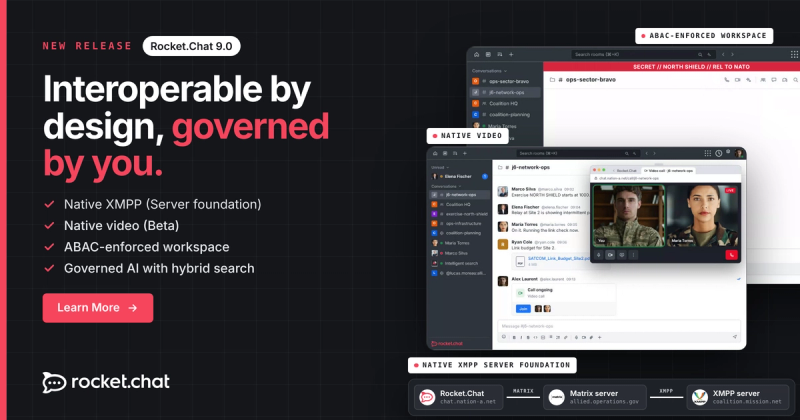
Federation. Secure communication across organizational boundaries, including coalition partners, cross-agency programmes, and allied nations, requires federation capability. Matrix protocol, XMPP, or equivalent enables this without routing traffic through a central third-party server. Federation with governance intact means the organization controls identity, moderation, and access policy for external connections, not an intermediary.
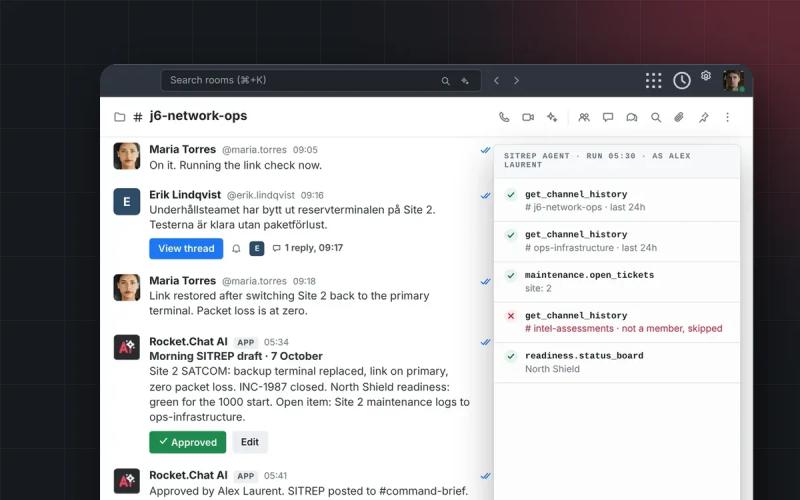
Extensibility with access controls. The platform should support custom workflows and integrations, but with scoped permissions. An extension framework that grants apps unrestricted access to all message data is a supply chain risk. Look for platforms that enforce least-privilege access for custom applications.
06Comparing the top open-source messaging platforms
See Table 2 below: feature comparison across all six platforms.
| Capability | Rocket.Chat | Mattermost | Element Matrix | Zulip | Wire | Wickr AWS |
|---|---|---|---|---|---|---|
| Self-hosted deployment | Yes | Yes | Yes | Yes | Yes | Yes |
| Air-gapped operation | Yes | Yes | With added engineering | No | Limited | Yes |
| End-to-end encryption | Yes | Yes | Yes | In transit | Yes | Yes |
| Customer-controlled encryption keys | Yes | Yes | Yes | Yes | Yes | Partial (AWS key dependency) |
| Federation (Matrix / XMPP) | Matrix + XMPP | No native federation | Native Matrix | No | No | No |
| Governed extensibility | Apps Engine (scoped permissions) | Plugins (broad access) | Limited app ecosystem | Integrations available | Limited | Limited |
| Audit logging | Full, exportable | Full, exportable | Yes | Basic | Limited | Yes |
| Open-source license | MIT | MIT / Apache 2.0 | Apache 2.0 | Apache 2.0 | GPL 3.0 | Partial (proprietary enterprise elements) |
| EU sovereignty suitability | Strong (global company, EU deployments) | Yes | UK-based, open protocol | No active EU govt references | Swiss jurisdiction | US-owned (AWS) |
07Platform breakdown
Rocket.Chat
Rocket.Chat is an open-source communications platform built for self-hosted, air-gapped, and hybrid deployment. It holds SOC 2 and ISO 27001 certifications and supports formal accreditation pathways aligned with GDPR and NIS2. On-premises deployment is documented and tested for high-assurance environments, including classified networks and sovereign cloud infrastructure. Its architecture is designed from the ground up as a sovereign communications platform: no external cloud dependency, customer-controlled encryption keys, and full audit logging.
The Apps Engine framework scopes what custom applications can access on a least-privilege model, so each app operates within defined permissions rather than having unrestricted access to communication data. Native Matrix and XMPP federation enables cross-organisation collaboration without routing traffic through external infrastructure. MIT licensing imposes no per-seat royalty and creates no AGPL complications for organizations that modify the codebase.
Key features
- Operates in air-gapped, classified, and DDIL environments with no external cloud dependency
- Apps Engine enforces least-privilege access for custom applications, scoping what each app can reach
- Native Matrix and XMPP federation enables governed cross-organisation collaboration without routing through external infrastructure
Best for: Government and public sector, defence and intelligence, critical infrastructure, cross-organisation collaboration.
Limitation: Feature depth requires considered deployment planning. Organizations with small IT teams may benefit from professional services support for initial configuration.
Mattermost
Mattermost is a strong open-source platform with established government deployment credentials. Self-hosted and air-gapped capable, with US military ATO, it is a solid choice for DevSecOps-heavy organizations with GitLab, Jira, and CI/CD pipeline requirements. Its plugin ecosystem covers a wide range of integrations across engineering and operations workflows.
Key features
- Deep DevSecOps integrations with GitLab, Jira, and CI/CD pipelines, purpose-built for engineering-heavy workflows
- Verified air-gapped deployment with US military ATO across federal and defence programmes
- Extensive plugin ecosystem covering a broad range of engineering and operations workflow integrations
Best for: US federal programmes, defence DevSecOps teams, engineering organizations.
Limitation: No native cross-organisation federation. Plugin integrations operate without scoped permission controls, placing supply chain vetting responsibility on the deploying organization.
Element
Element is built on the Matrix open standard, which provides decentralized federation as a first-class feature. Any Matrix-compatible server can communicate with any other without a central intermediary, making it a strong model for coalition communication and cross-agency interoperability. Element is UK-based, easing EU sovereignty concerns relative to US-owned alternatives.
Key features
- Native Matrix federation allows any Matrix-compatible server to communicate with any other without a central intermediary
- Built on an open standard, meaning interoperability is protocol-level, not vendor-dependent
- UK-based with no US-jurisdiction concerns, strong fit for EU institutional and NATO interoperability programmes
Best for: Coalition communication, EU institutional interoperability, decentralized government networks.
Limitation: Enterprise governance features and extensibility are less mature than Rocket.Chat or Mattermost. Large-scale deployment requires more operational overhead.
Zulip
Zulip's topic-based threading model organizes conversations around subjects rather than channels. This suits technical and research teams but is less intuitive for operational communication environments. Self-hosted deployment is supported; air-gapped operation and cross-organisation federation are not natively available.
Key features
- Topic-based threading organizes conversations by subject, making asynchronous discussion easier to follow and search
- Powerful message history and search, with topics making past conversations highly navigable
- Straightforward self-hosted deployment and management for technical teams
Best for: Engineering and research teams, asynchronous-heavy workflows.
Limitation: Not suited to real-time operational environments or classified deployment requirements.
Wire
Wire offers strong end-to-end encryption across text, voice, and video in a clean cross-platform interface. Swiss jurisdiction provides a strong data residency story for European organizations. Enterprise Wire deployments are self-hosted. Integration and federation capabilities are limited relative to Rocket.Chat and Element.
Key features
- Swiss jurisdiction provides a strong data residency story with no US-jurisdiction exposure
- End-to-end encryption applied by default across text, voice, and video without additional configuration
- Clean, consistent cross-platform interface across mobile and desktop, lowering the barrier to adoption
Best for: Corporate teams requiring strong encryption, EU organizations prioritizing data residency and clean user experience.
Limitation: Limited extension ecosystem and no native Matrix or XMPP federation.
Wickr (AWS)
Wickr is purpose-built for secure, ephemeral messaging in defence contexts, with US government accreditation and air-gapped deployment support. Its AWS ownership is both a strength (enterprise support, US FedRAMP pathway) and a constraint for European sovereign procurement. Wickr's enterprise edition includes proprietary elements.
Key features
- Purpose-built for ephemeral, high-security messaging with automatic message expiration and minimal data retention
- Verified air-gapped deployment with US government accreditation, widely used in US military and intelligence contexts
- AWS infrastructure integration provides enterprise-grade scalability and compatibility with existing AWS-invested environments
Best for: US federal and military programmes, organizations already in the AWS ecosystem.
Limitation: AWS ownership creates foreign-jurisdiction dependency that conflicts with European digital sovereignty requirements. Not fully open source in the same sense as the other platforms in this comparison.
08Which open-source messaging platform is right for government, defence, and critical infrastructure?
The platform decision depends more on operational context than on feature lists alone. Three questions narrow the shortlist.
Does the environment require air-gapped operation? If yes, Rocket.Chat, Mattermost, and Wickr are the only platforms in this comparison with verified air-gapped deployments. Element can be configured for isolated operation but requires more infrastructure engineering.
Is cross-organisation federation a core requirement? For coalition programmes, cross-agency collaboration, or EU institutional interoperability, native federation matters. Rocket.Chat and Element are the strongest options. Mattermost and Wire do not offer native Matrix or XMPP federation.
How extensive is the customisation requirement? For critical infrastructure and government organizations with operational workflows that standard tools do not cover, Rocket.Chat's Apps Engine provides the most governed extensibility in this comparison. Self-hosted government chat with custom workflow integration is a live deployment scenario across multiple government environments, not a theoretical capability.
See Table 3 below: use case fit by vertical and scenario.
| Use case | Best platform s | Key requirement | Why this fit |
|---|---|---|---|
| EU and national government collaboration | Rocket.Chat, Element | GDPR compliance, EU data residency, Schrems II compatibility | Self-hosted, EU-jurisdiction deployment; proven at eu-LISA and City of Cologne |
| Defence and command operations (C2) | Rocket.Chat, Mattermost, Wickr | Air-gapped deployment, ATO pathway, DDIL resilience | Verified air-gapped operation; classified programme deployments; accreditation support up to IL6 (Rocket.Chat) |
| Critical infrastructure incident response | Rocket.Chat | Out-of-band communications; operates when primary networks are compromised | Runs independently of external cloud; NIS2-aligned operational continuity |
| Cross-agency and coalition collaboration | Rocket.Chat, Element | Cross-organisation federation with governance and identity control intact | Native Matrix and XMPP federation; organizations retain moderation and access policy |
| NATO and EU defence programmes | Rocket.Chat, Element | FMN (Federated Mission Networking) interoperability; sovereign deployment; DDIL operation | Matrix / XMPP federation supports FMN architecture; proven NATO-member deployments |
| DevSecOps and engineering teams | Mattermost, Zulip | Deep CI/CD, GitLab, Jira integrations; developer-oriented UI | Purpose-built DevSecOps toolchain integrations; Zulip's threading suits async engineering workflows |
| Skype for Business Server migration | Rocket.Chat | On-premises deployment; voice and video; data migration support; no cloud dependency | Full-feature replacement for organizations moving off legacy Microsoft on-premises collaboration |
09Why Rocket.Chat leads for sovereign, air-gapped, and regulated deployments
Every platform in this comparison addresses part of the sovereign communications problem. Rocket.Chat is the only one that addresses the full set of requirements: no proprietary lock-in, no foreign-jurisdiction infrastructure, and no trade-off between extensibility and security.
It operates where others cannot. Air-gapped, classified, and DDIL (Disconnected, Degraded, Intermittent, or Limited) environments are primary deployment contexts for Rocket.Chat, not edge cases. Active programmes demonstrate operational readiness in the most demanding conditions. Agencies report up to 2.5x faster decision-making during critical operations with centralized, sovereign communications.
Extensions operate inside a security boundary. Apps Engine scopes what custom applications can access. A custom app cannot silently reach all message content or all user data. For environments where supply chain integrity is formally audited, which includes most government and critical infrastructure procurement processes, this distinction is not cosmetic.
Federation happens with governance intact. Native Matrix and XMPP federation enables cross-organisation communication without routing through a third-party server. Coalition partners, allied agencies, and external collaborators are reached directly, with identity, moderation, and access controls defined by the organization, not by a neutral intermediary whose terms may change.
European credentials are operational. eu-LISA, the City of Cologne, and the Swedish Electrical Safety Board are not reference customers in name only. They are operational deployments in live EU environments with formal data protection obligations. MIT licensing means no AGPL complications for custom modifications. The codebase is auditable by national security agencies, certification bodies, and customer security teams without restriction.
For organizations with sovereignty, compliance, and resilience requirements that commercial SaaS cannot meet, Rocket.Chat provides a deployment model that has already been validated where the requirements are most demanding.
Frequently asked questions
What is an open-source messaging platform?
An open-source messaging platform is a communication tool whose source code is publicly available for inspection, modification, and distribution. Unlike proprietary tools, where the vendor controls the code and infrastructure, open-source platforms allow organizations to audit the codebase, modify it to meet specific requirements, and deploy it on their own infrastructure. This gives organizations full ownership of their data and eliminates dependency on a vendor's commercial decisions.
Are open-source messaging platforms secure enough for government use?
Open-source messaging platforms are widely deployed in government and defence environments precisely because of their security model. Public code can be audited by internal security teams, national certification bodies, and third-party assessors, a level of verifiability that closed proprietary code cannot provide. Platforms such as Rocket.Chat are in active use across NATO-member defence organisations, confirming that open-source architecture is compatible with the most demanding security requirements.
How do open-source messaging platforms support GDPR compliance?
Self-hosted open-source messaging platforms keep data processing entirely within the organization's own infrastructure, eliminating cross-border transfers to vendor-controlled cloud systems. This directly addresses the core requirement under GDPR for data residency and the Schrems II ruling's constraints on transfers to US-jurisdiction systems. The organization, not the vendor, controls data location, encryption keys, and retention policies. This is the architecture GDPR requires, not just a configuration preference.
What is the difference between Rocket.Chat and Mattermost?
Both Rocket.Chat and Mattermost are enterprise-grade, self-hosted open-source platforms with strong security postures and support for air-gapped deployment. The key distinctions are extensibility, federation, and ownership. Rocket.Chat's Apps Engine governs what custom applications can access, reducing supply chain risk compared to Mattermost's plugin architecture. Rocket.Chat offers native Matrix and XMPP federation for cross-organisation collaboration; Mattermost does not. Rocket.Chat is MIT-licensed and globally distributed.
Which open-source messaging platform is best for European public sector organizations?
Rocket.Chat and Element are both deployed in European public sector environments and address EU sovereignty requirements. Rocket.Chat's combination of self-hosted deployment, Apps Engine extensibility, native Matrix federation, and operational deployments at eu-LISA, the City of Cologne, and the Swedish Electrical Safety Board makes it the strongest option for organizations navigating GDPR, NIS2, and EUCS requirements simultaneously. Element is also a strong choice where decentralized Matrix-native federation is the primary requirement, such as cross-agency interoperability programmes.
Can open-source messaging platforms operate in air-gapped environments?
Yes. Rocket.Chat, Mattermost, and Wickr all support verified air-gapped deployment, where the platform runs with no connection to external networks or the public internet. This is a hard requirement for classified government networks, isolated operational technology environments, and out-of-band communication systems designed to remain functional when primary networks are compromised or under attack. Most commercial SaaS platforms cannot be deployed in air-gapped configurations regardless of other security capabilities.
How does NIS2 affect the choice of messaging platform?
NIS2 requires operators of essential services to maintain operational continuity of communications and to manage supply chain security across every component of their technology stack. A vendor-controlled SaaS messaging platform creates two compliance risks: an external dependency that can disrupt continuity if the vendor experiences an outage or is subject to legal process, and a supply chain element the organization cannot audit or control. Self-hosted open-source platforms address both risks by keeping infrastructure within organizational control and making the codebase auditable. Organizations subject to NIS2 should verify that their chosen platform can operate independently of any external cloud provider.