- Open source government communication platforms give agencies full control over data, code, and infrastructure, while proprietary tools keep encryption keys and data under vendor jurisdiction.
- European regulators, NIS2, and GDPR are accelerating the shift to open source alternatives.
- The EU study found open source delivers a cost-benefit ratio above 1:4 for organizations that use and contribute to it.
- Platforms like Rocket.Chat, Mattermost, and Element support air-gapped deployment, self-hosting, and end-to-end encryption natively.
- Microsoft Teams and Slack remain subject to US jurisdiction under the CLOUD Act, regardless of where their EU data centers are located.
Government agencies face a fundamental question when choosing communication tools: who ultimately controls your data? For public sector organizations handling sensitive citizen information, classified communications, or cross-agency coordination, the answer matters enormously.
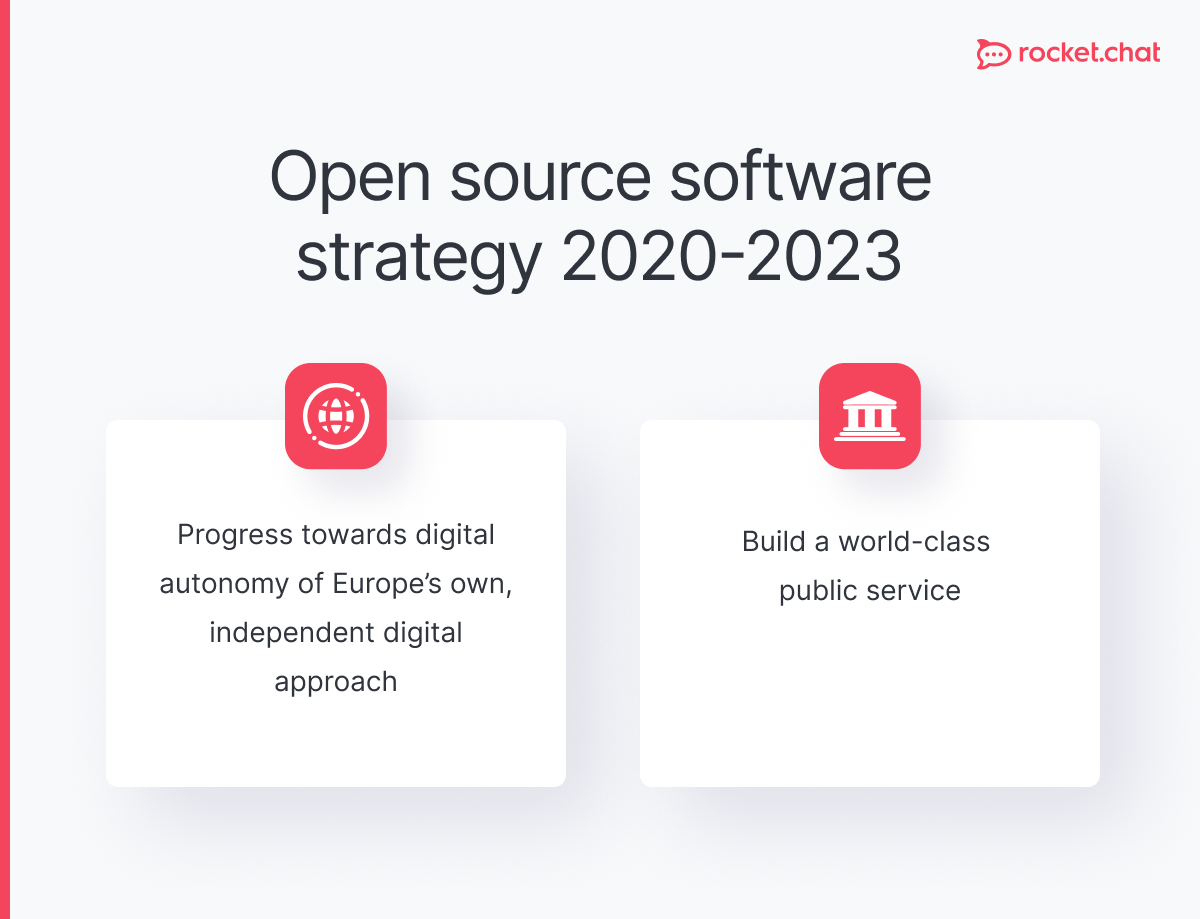
Open source government communication platforms have moved from niche alternatives to mainstream policy across the EU. The European Commission has maintained an open source strategy since 2000, now in its fifth iteration, with a clear mandate: where open source is available and fit for purpose, it should be the preferred choice. The Linux Foundation's 2024 research confirms that government is the second-largest sector poised to benefit from open source investment, cited by 36% of respondents across Europe.
This guide breaks down what that choice actually means in practice, and how to make it.
What makes a platform "open source" for government?
Open source software means the source code is publicly available for inspection, modification, and redistribution. For government, this translates into three concrete benefits:
- Auditability. Any security researcher, government IT team, or third-party auditor can verify what the code actually does. This is impossible with proprietary tools where the vendor controls the source.
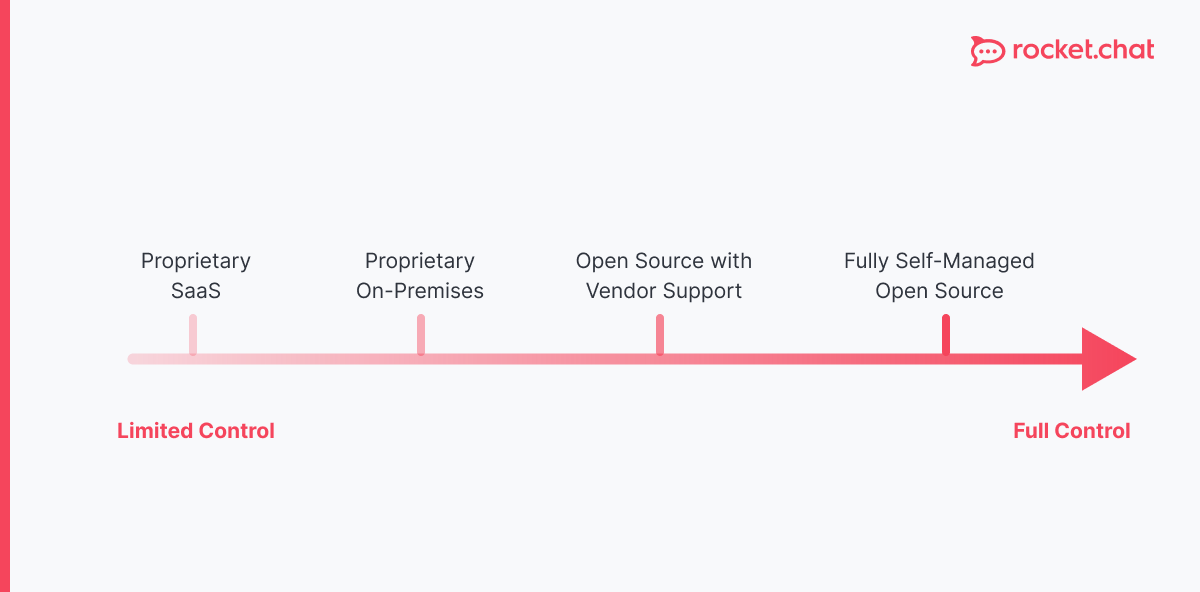
- Sovereignty. Self-hosted open source platforms keep data, encryption keys, and infrastructure entirely under the agency's control. The vendor has no technical access to your communications.
- No vendor lock-in. Proprietary platforms bundle licensing, hosting, and data in a way that makes migration costly. Open source platforms use standard protocols and formats, making data portable.
Open source government platforms: the main options
Rocket.Chat
Rocket.Chat is a fully open source collaboration platform built for organizations that need secure government communication with complete data ownership. It supports self-hosted deployment, air-gapped environments, end-to-end encryption, and federation with other agencies. Its modular architecture allows agencies to extend functionality without relying on vendor roadmaps.
For European governments specifically, Rocket.Chat offers on-premises deployment in any sovereign cloud or private data center, making it compatible with both GDPR-compliant messaging requirements and national data residency laws.
.avif)
Mattermost
Mattermost positions itself as an open source alternative to Slack, with strong DevSecOps integrations. It is popular among defense and intelligence agencies in the US and has a transparent per-user licensing model. Its open source core is auditable, and the platform supports air-gapped deployment.
Element (Matrix protocol)
Element is built on the Matrix protocol, a federated, open standard for real-time communication. It pioneered end-to-end encryption for federated messaging and enables secure cross-agency communication without routing data through a central server. Its complexity can create operational challenges for large government deployments, but it remains the gold standard for encrypted messaging in fully federated environments.
Platform comparison
Why proprietary platforms fall short for government
Microsoft Teams and Slack are excellent tools for many enterprise contexts, but they have structural limitations for government use that cannot be resolved by contract or by EU data center selection.
- Jurisdictional exposure. Both platforms fall under US jurisdiction and are subject to the CLOUD Act, which allows US law enforcement to compel data access regardless of where servers are located. An EU data center does not resolve this.
- Encryption key control. Microsoft holds Teams encryption keys by default. This means Microsoft can access message content if legally compelled to do so. Secure team chat for government requires that only the agency holds keys.
- No independent verification. Closed-source architecture means agencies must trust vendor security claims rather than verify them. For environments handling classified or sensitive data, this is not acceptable.
- Cloud dependency. Teams cannot be deployed in an air-gapped environment. For agencies handling classified communications or operating in disconnected environments, this is a hard disqualifier.
- Cost escalation. Proprietary platforms bundle communication into broader licensing agreements (e.g., Microsoft 365), creating dependencies that make migration costly over time. The EU has documented that open source delivers a cost-benefit ratio above 1:4 compared to proprietary alternatives when organizations contribute back to the codebase.
For a detailed platform-by-platform comparison including data sovereignty scores, see Microsoft Teams alternatives for European government.
Regulatory context: NIS2, GDPR, and digital sovereignty
The regulatory environment is actively pushing government agencies toward open source. NIS2, whose transposition deadline across EU member states was October 2024, requires essential entities, including government bodies, to implement "state-of-the-art" security measures and maintain supply chain security. Proprietary platforms where the vendor controls encryption and infrastructure create supply chain risks that are difficult to mitigate under NIS2. Learn more in our NIS2 compliance guide.
GDPR requires data controllers to implement appropriate technical measures and to maintain clear accountability for data processing. Using a platform where the vendor controls encryption keys complicates this accountability chain significantly.
Digital sovereignty is now an explicit policy objective for the European Commission and several member states. France, Germany, and the Netherlands have each pursued open source adoption in public sector IT through legislation, national programmes, or state-level migration initiatives. The "public money, public code" principle, supported by 82% of European open source survey respondents according to the Linux Foundation, holds that software built with public funds should be available to the public.
Total cost of ownership: the full picture
Procurement decisions often compare licensing costs directly, which favors proprietary tools that offer bundled pricing. Total cost of ownership (TCO) tells a different story.
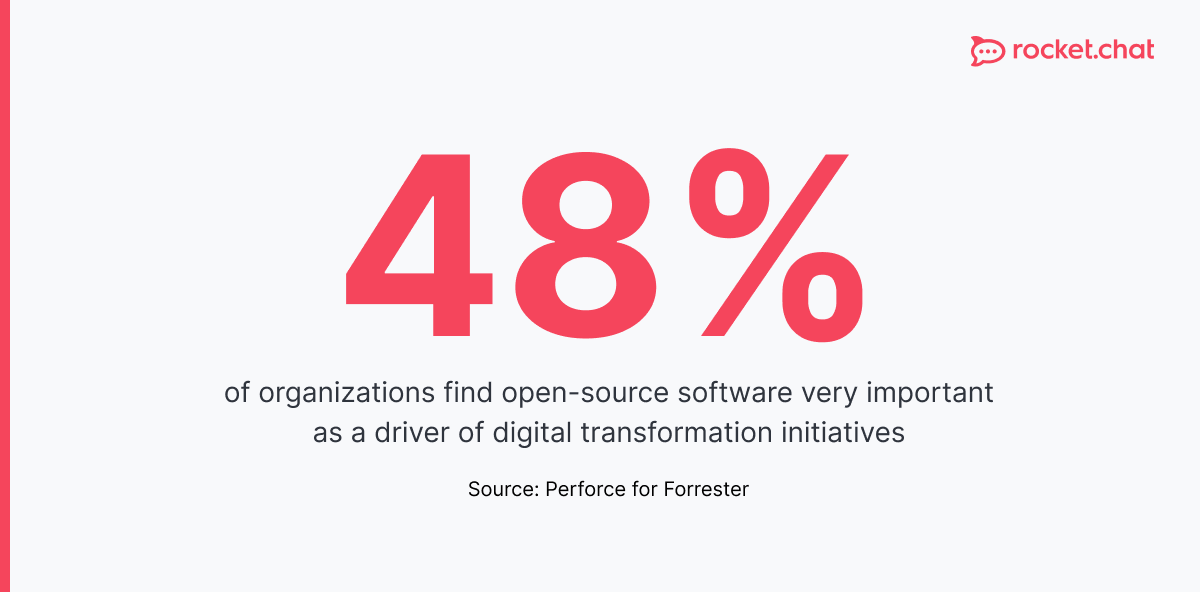
Open source platforms have higher upfront implementation costs: infrastructure setup, migration, and staff training. Unlike proprietary tools where per-user licensing is non-negotiable and subject to vendor price increases, open source platforms give agencies the option to self-host at no licensing cost, with commercial support available when needed. Over a five-year period, most government deployments find that open source TCO is significantly lower, while also eliminating the risk of licensing price increases at renewal.
The EU's study on open source economics found a cost-benefit ratio above 1:4, meaning every euro invested in open source returned over four euros in value across government and enterprise deployments. This figure accounts for implementation costs, support, and ongoing maintenance.
Additional factors that reduce proprietary platform TCO comparisons: vendor-imposed migration costs when switching, audit costs when you cannot verify vendor security claims independently, and compliance costs when proprietary architecture makes GDPR accountability harder to demonstrate.
Decision framework: how to choose
Choose open source if:
- Your agency handles sensitive, classified, or personal citizen data
- You operate under NIS2, GDPR, or national data residency laws
- You need air-gapped or on-premises deployment capability
- You require independent security audits of your communication infrastructure
- You want to avoid long-term vendor lock-in and licensing escalation
Consider proprietary platforms if:
- Your use case is entirely non-sensitive internal coordination
- Your organization lacks internal IT capacity for self-hosted deployment
- You require deep integration with an existing Microsoft 365 or Google Workspace environment and are not handling sensitive data
For most government contexts, the first list applies. For agencies moving away from proprietary tools, a sovereign Slack alternative for Europe is a practical starting point.
Getting started with open source government communication
Moving to an open source platform does not require replacing everything at once. Most agencies start with a specific team or use case, validate the deployment, and expand from there.
Key steps: assess your current data handling and compliance requirements, identify whether your use case requires air-gapped deployment or standard cloud self-hosting, evaluate platforms against your security certification requirements, and plan for staff migration and training.
Rocket.Chat provides dedicated deployment support for government agencies and can be hosted on sovereign European infrastructure. Explore government messaging capabilities and secure collaboration tools designed for public sector requirements.
Frequently asked questions about <anything>
open source solutions for government
What is open source government communication software?
Is open source software secure enough for government use?
Can open source communication platforms be deployed in air-gapped environments?
How does GDPR apply to government communication platforms?
Does NIS2 require government agencies to use open source communication tools?
What is the cost difference between open source and proprietary communication platforms for government?
Which open source platform is best for European government agencies?


- Digital sovereignty
- Federation capabilities
- Scalable and white-labeled

- Highly scalable and secure
- Full patient conversation history
- HIPAA-ready

for mission-critical operations
- On-premise and air-gapped ready
- Full control over sensitive data
- Secure cross-agency collaboration
%201.svg)
- Open source code
- Highly secure and scalable
- Unmatched flexibility

- End-to-end encryption
- Cloud or on-prem deployment
- Supports compliance with HIPAA, GDPR, FINRA, and more

- Supports compliance with HIPAA, GDPR, FINRA, and more
- Highly secure and flexible
- On-prem or cloud deployment